Legislative Tracking Spreadsheet vs MassTrac
When you need to keep tabs on legislation at the Massachusetts State House, a spreadsheet may seem like the obvious place to start. It’s familiar, flexible, inexpensive, and easy to customize. Add a few columns for bill numbers, sponsors, status, and notes, and you have a legislative tracking system up and running.
For some organizations, that may be all they need. But we also know the reality of the Massachusetts State House.
As the number of bills you’re following grows, and as those bills begin moving through committees, hearings, amendments, and votes, the challenge is keeping that data current. There’s also virtually no learning curve. If your team already uses Excel or Google Sheets, you can start immediately.
For organizations that only need to watch a handful of known bills and don't need frequent updates, a spreadsheet can be a perfectly reasonable solution.
If you want to try it yourself, download our free Massachusetts Bill Tracking Spreadsheet to create your own legislative watchlist.
Free Massachusetts Bill Tracking Spreadsheet
The Case for Tracking Legislation in a Spreadsheet
Spreadsheets have several advantages, especially if you’re following a relatively small number of bills.
You can create fields for the information that matters to your organization, such as bill number, title, sponsor, committee, issue area, current status, priority, position, notes, and relevant links. You can sort bills by priority or issue and share the file with colleagues.
With its simplicity, things start out all well and good.
The Realities of Manual Bill Tracking
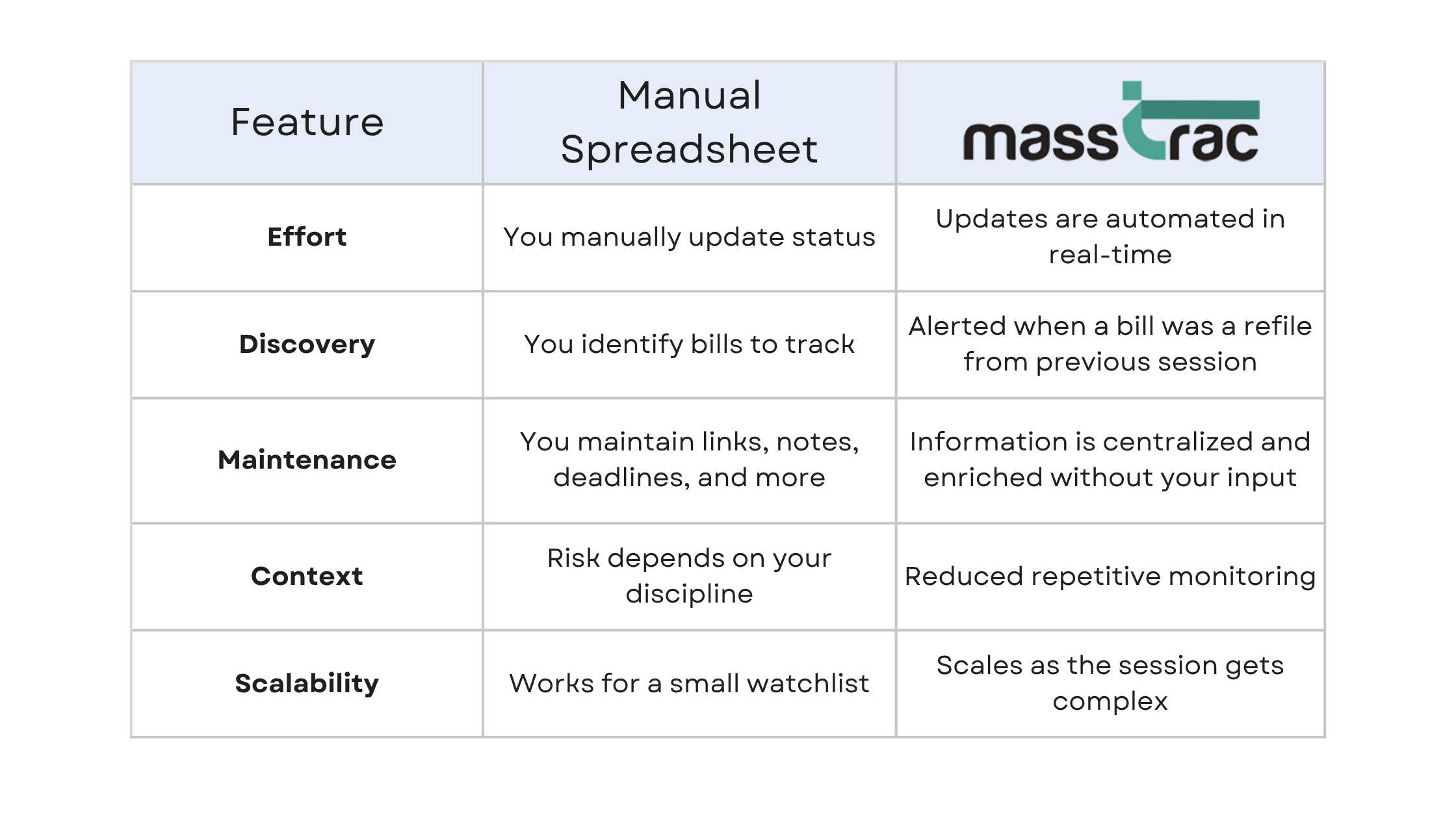
A spreadsheet only contains the information someone puts into it. Someone still has to check each bill for new activity, see if a hearing has been scheduled, if the bill number changed, or if there is any other new development that your stakeholders need to know about.
Multiply those checks across dozens of bills and instead of working on legislative strategy, you’re stuck doing data entry.
The problem isn't the spreadsheet itself; it's the time required to keep it useful.
What changes with MassTrac
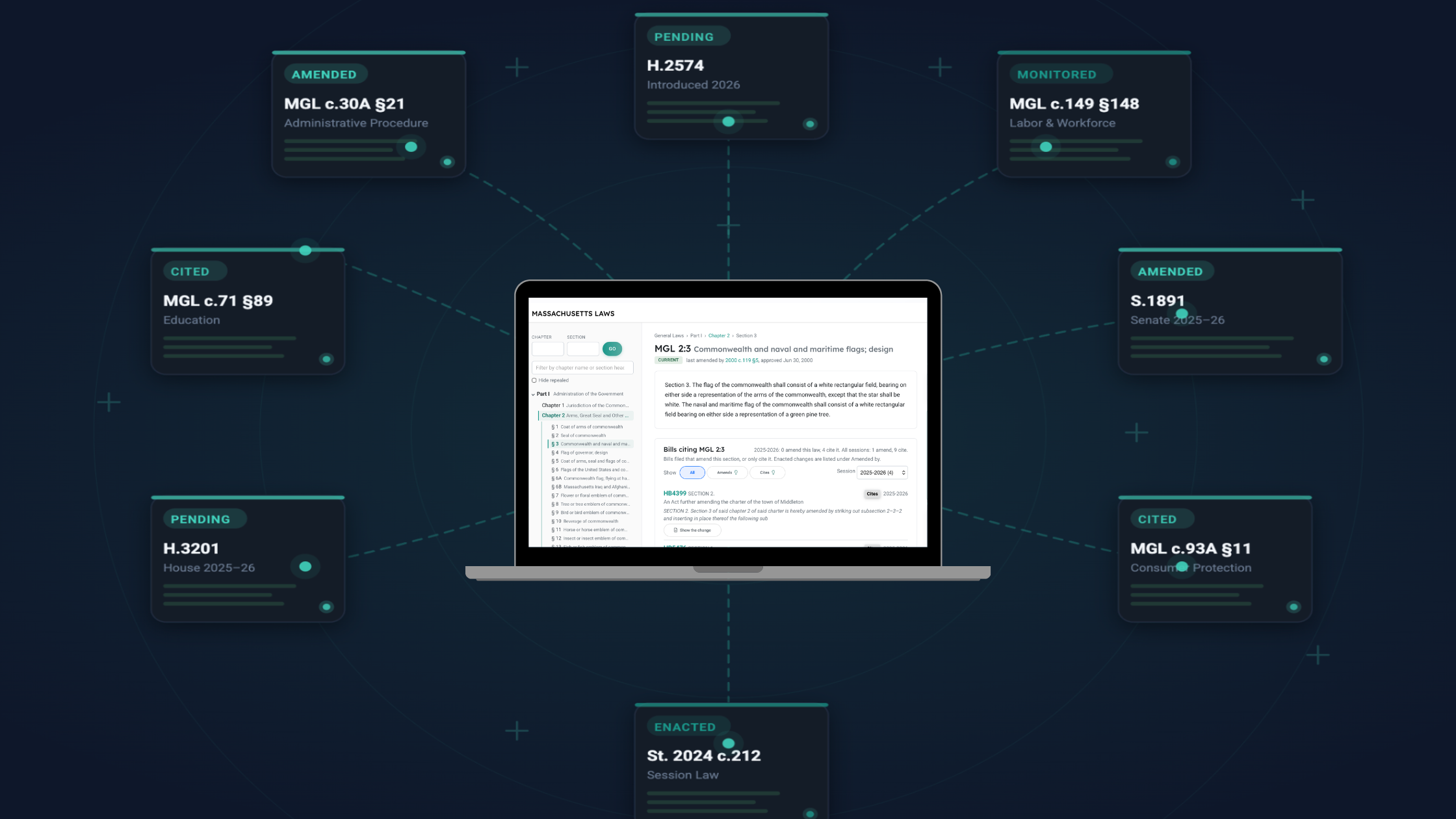
The fundamental difference between a spreadsheet and MassTrac is the real-time alerts feature. Instead of repeatedly checking bills and manually recording changes, you can use real-time alerts and a personalized command center to stay on top of the legislation that matters to you. This means you're spending less time looking for an update and more time deciding what that update means.
MassTrac also goes beyond tracking individual bill activity. The platform turns data into intelligence you can actually use and communicate.
Data is the bill number in your tracker, but it’s static. Intelligence is the plain-language summary that explains how that bill affects your organization’s bottom line. Data is the fact that a hearing occurred. Intelligence is the ability to search the transcript of that hearing, jump to the exact moment your issue was debated, and share a clip of that exchange with your stakeholders.
MassTrac was built to automate the heavy lifting and provides you the speed of automation with the nuance of a Beacon Hill insider.
So, when should you make the switch?
You don't need to abandon a spreadsheet simply because a purpose-built platform exists.
The better question is whether your manual process still works for you.
Consider how your team operates today:
How many bills are you actively following?
How often does someone check those bills for changes?
What happens when legislative activity picks up?
How quickly do clients, executives, members or colleagues expect an update?
How costly would it be to miss an important development?
If you're tracking a manageable number of bills and occasional checks are enough, keep the spreadsheet.
If your team is spending hours maintaining it, worrying about what it might have missed or struggling to keep up during a busy stretch of the session, invest in MassTrac.
We aren't here to tell you that spreadsheets are obsolete. We’re here to help you when the spreadsheet is no longer enough. If you’re spending more time updating your rows and columns than using that information to drive your advocacy, you’ve lost the strategy.
When you’re ready to start managing your influence and ditch the list, book a demo with the MassTrac team.