The Ballot Question Passed. Now Beacon Hill Gets Involved.
Election day settles whether voters want a policy via ballot questions, but it often doesn’t settle what the policy will actually look like once Beacon Hill gets involved. Following the record-tying 9 ballot questions from the November 2026 election, voters are now watching as lawmakers turn those results into law. While voters across Massachusetts weighed in on proposals ranging from transparency to housing and gun safety, Election Day was only the beginning. The real test comes next as potential legislative tweaks and inevitable court battles determine how these voter-approved policies will function in practice.
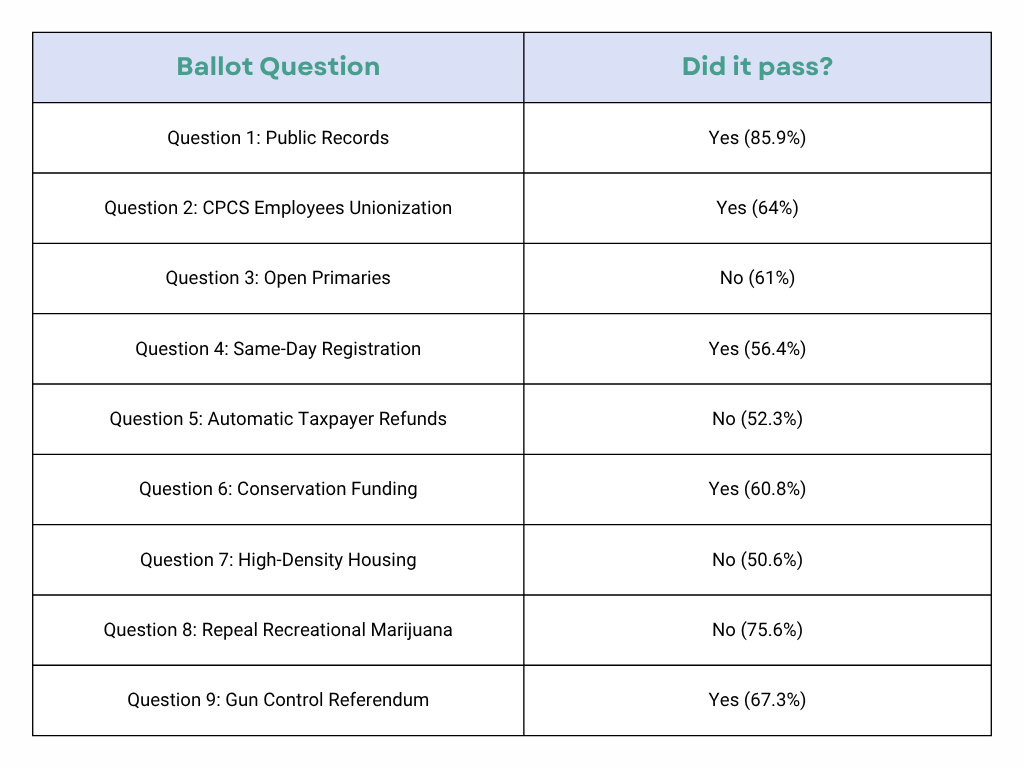
2026 Massachusetts Primary Election Ballot Question Results, via CBS News and the Associated Press
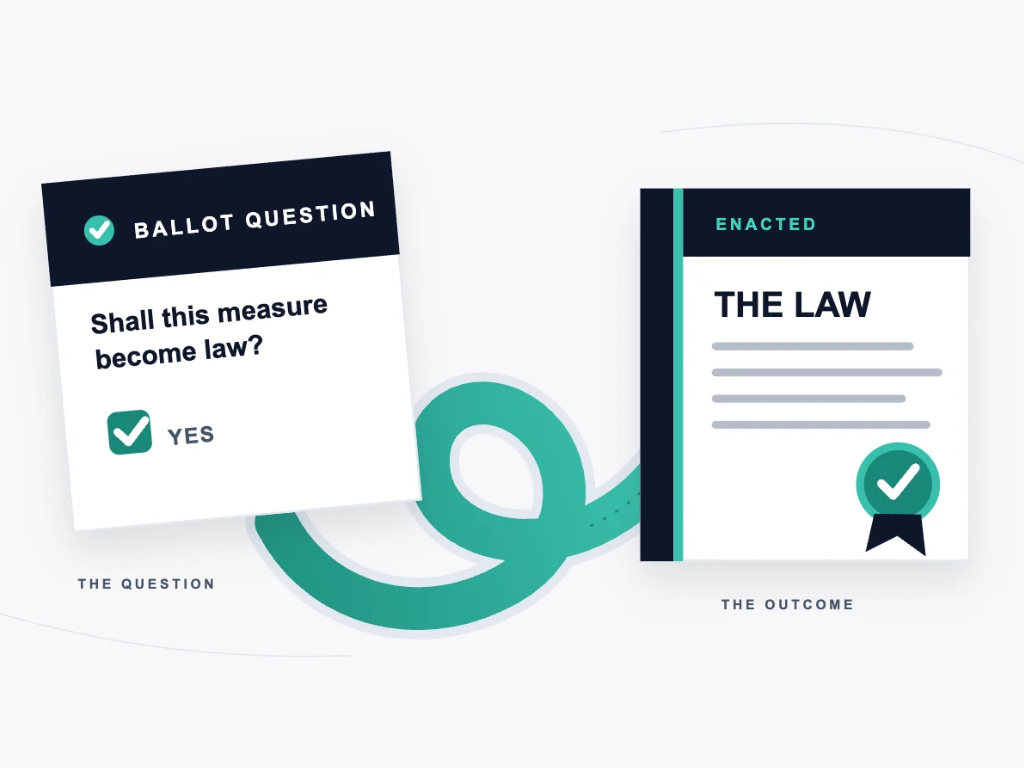
With 5/9 ballot questions passing, does this mean that they are now laws?
Technically, once the measures are passed, they become law, but how they are implemented often requires more action from lawmakers, even before promulgation of state agency regulations, establishing programs, hiring staff, and more.
Article 48 of the Massachusetts Constitution outlines the framework for ballot initiatives following a general election. For the voter-approved statutory initiatives, actual implementation ultimately rests with the State Legislature. Under Article 48, Beacon Hill lawmakers retain full constitutional authority to amend, slow-walk, or repeal laws passed by voters.
Precedent of What Beacon Hill involvement looks like
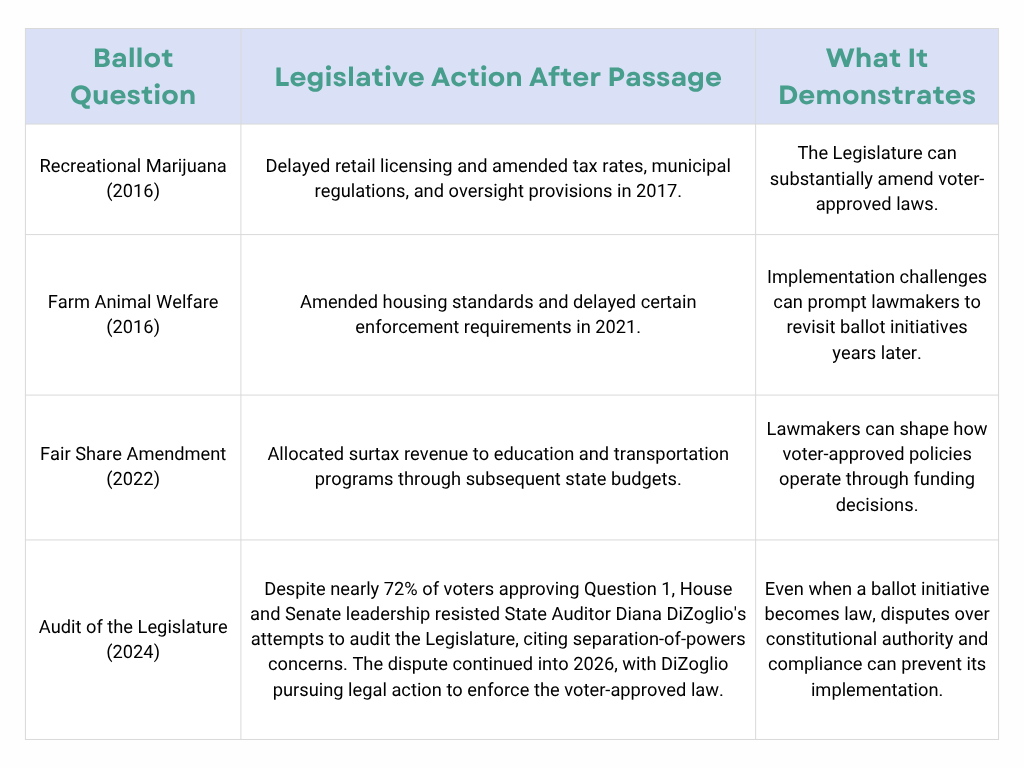
The Legislature's intervention in voter-approved measures is standard procedure on Beacon Hill. For example, after voters approved recreational marijuana legalization in 2016, lawmakers stepped in just months later to alter the law's tax structures, local control provisions, and implementation timeline. This early friction foreshadowed subsequent administrative turmoil at the Cannabis Control Commission – including high-profile leadership clashes involving figures like Shannon O'Brien – as regulators grappled with unforeseen statutory nuances.
That same year, voters approved new farm animal welfare standards, which the Legislature later amended in 2021 to address implementation concerns and delay certain requirements.
Other ballot initiatives have required continued legislative involvement without changing the underlying policy. Following the approval of the Fair Share Amendment in 2022, which established an additional tax on income above $1 million, lawmakers were (and are still) responsible for allocating the resulting revenue to education and transportation through the state budget.
And most notably, the 2024 ballot question granting the State Auditor authority to audit the Legislature, has made the news because of inaction; lawmakers responded with closed-door negotiations and competing legislation to restrict the scope of potential probes. There is a law on the books, but it is not being practiced because the Legislature is responding with their own bill.
Together, these examples illustrate that while voters can establish policy through ballot initiatives, the Legislature often continues to shape how those policies are implemented and enforced. The extent of legislative authority also depends on whether voters approved an ordinary law or a constitutional amendment. Although lawmakers can amend or repeal voter-approved statutes, they cannot change a constitutional amendment through ordinary legislation.
The questions that passed
Question 1 - Public Records
Question 1 passed overwhelmingly, commanding 86% of the vote and taking effect January 1, 2027. This ballot question explicitly adds the House, Senate, and Governor's office to the public records law, addressing Massachusetts' status as the only state where all three branches claim blanket exemptions. However, lawmakers are currently negotiating compromise public records legislation in a closed-door conference committee. Titled An Act promoting transparency and public access in state government, this pending legislative package directly conflicts with Question 1.
The Senate version establishes its own statutory language as the "sole and exclusive remedy" for legislative records, carving out narrower disclosures and potentially undercutting the broader mandate approved by voters. The biggest difference is that the House bill restricts the state auditor’s authority to audit the Legislature, while the Senate amendment removes that entire audit section. The versions also differ on access to records and how denials can be challenged. Together, both Senate and House versions would make Question 1’s disclosure systems more narrow.
If the Legislature passes its compromise bill before or after the January 1 enactment date, it sets up an immediate legal clash. State Auditor Diana DiZoglio has already vowed to take legal action against any legislative attempt to alter or weaken Question 1, while Governor Maura Healey has pledged to veto legislation designed to mitigate the measure's scope. Expect a multi-year battle in the courts and state house committee rooms before final implementation rules are established.
Question 2 - CPCS Employee Unionization
Employees at the Committee for Public Counsel Services (CPCS) – including public defenders, secretaries, and social workers – were barred from collective bargaining, despite over 180 other state agencies having that right. Bills attempting to grant them bargaining rights had stalled and failed across six consecutive legislative sessions due to leadership resistance.
Because the measure passed, CPCS employees are now legally empowered to form a union and negotiate with agency management over working conditions and pay. However, any resulting financial agreements will still require sign-off from the Governor and actual funding appropriations from the Legislature, meaning budget talks and implementation will require ongoing interaction with Beacon Hill.
Question 4 - Same-Day Voter Registration
This reform was championed for nearly a decade by Secretary of State William Galvin, but repeatedly met with inaction and shrugs from leadership on Beacon Hill, prompting Galvin and advocacy groups (such as Common Cause MA and the ACLU) to take it directly to voters.
Starting in 2028, eligible voters will be able to register or update their registration right at their polling place on Election Day (with proof of residency and a written oath). For municipal elections next year, current deadlines (10 days in advance) remain in place. The state will now need to operationalize the administrative and polling place infrastructure required by the new mandate ahead of the next presidential cycle.
Related legislation could further shape implementation: Senate proposals (which were sent to study, and therefore presumably dead) would extend same-day registration to early voting and modernize the voter-registration systems used by local election officials. If enacted, those changes would require coordination with Question 4’s Election Day procedures.
Question 6: Conservation Funding
Environmental groups and advocates pushed to secure dedicated funding for nature conservation without raising taxes, noting that state funding for open spaces has lagged behind needs for years.
The measure creates a dedicated nature conservation fund fueled by existing sales tax revenue collected from sporting goods, camping gear, hunting/fishing equipment, and golf equipment. While voters approved the funding stream, lawmakers on Beacon Hill retain the ultimate authority over budget allocations. Some legislators have expressed fiscal caution regarding carving out specific tax revenues from the General Fund during tight budget cycles, meaning environmental advocates will need to lobby appropriations committees to ensure the funds are actively deployed.
Question 9: Gun Control Referendum (Keeping the 2024 Firearms Safety Law)
In 2024, the Legislature passed a sweeping gun safety package (Chapter 135) enhancing training requirements, age limits, and regulations on ghost guns and 3D-printed firearms. Governor Healey signed it with an emergency preamble to take effect immediately. Gun rights groups subsequently gathered signatures to put a repeal referendum on the ballot.
With voters rejecting the repeal and affirming the 2024 law, the statutory framework remains fully in force. Lawmakers and state police will continue implementing the updated training curricula and registration databases. Meanwhile, Second Amendment groups have signaled they will continue monitoring enforcement and legal challenges, while other groups are eyeing future ballot measures.
As implementation moves forward, new legislation can be filed, amendments considered, hearings scheduled, and regulatory details debated that ultimately shape how the policy works in practice. MassTrac helps you follow that process from Beacon Hill, tracking the bills, committees, hearings, and legislative activity that could affect a voter-approved law long after Election Day. Book a demo to see how MassTrac can help you stay ahead of what happens next.
Ready to transform your public affairs workflow?
Join over 380 organizations who trust InstaTrac
Book Demo