What to look for in a Municipal Meeting Records Platform
What to look for in a Municipal Meeting Records Platform
Municipal meeting minutes are the foundation of local democracy. They’re also a workload problem.
Between open meeting laws, public records requests, and the volume of boards and committees most cities and towns run, staff are often the ones absorbing the pressure.
Records software is supposed to relieve that and not add to it. If your municipality is evaluating a vendor, here’s what to prioritize:
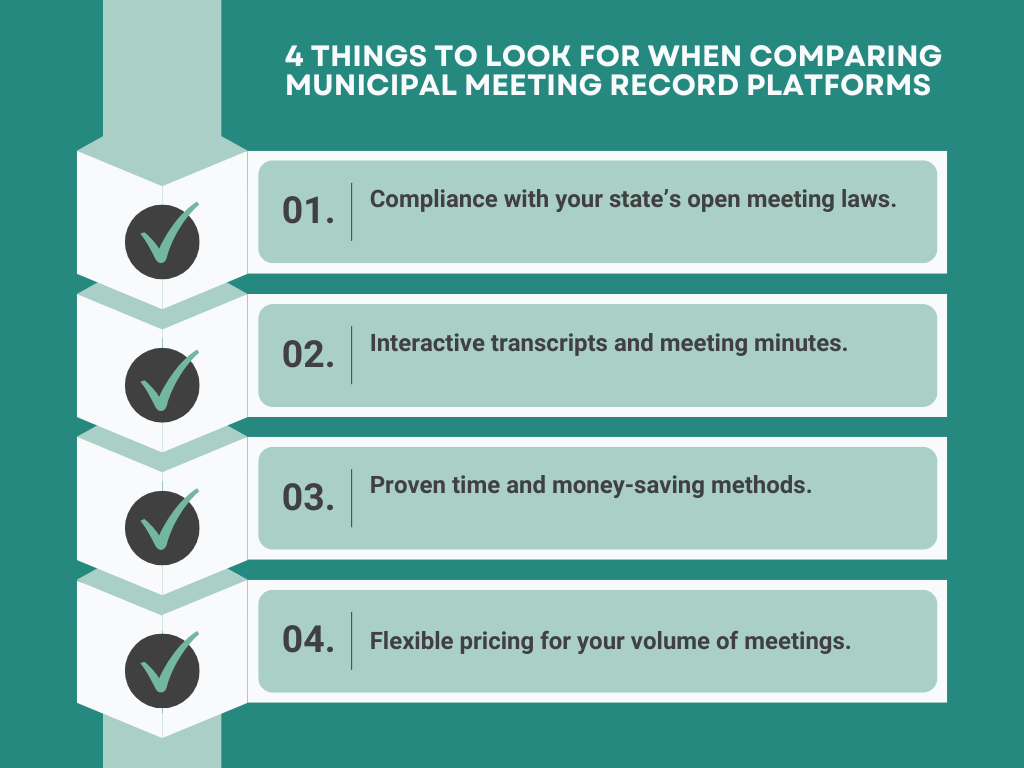
Compliance with State Law
The software you choose should help you meet your state’s legal requirements, not complicate them.
In Massachusetts, that means following the Open Meeting Law. Advance notice, public access, and timely, accurate minutes are statute, not suggestions. A good minutes and transcription platform should shorten the distance between “meeting held” and “minutes posted,” and leave an auditable trail along the way.
Useable Transcripts, Not Just Minutes
Publishing minutes is the baseline. Making them usable is the real test.
The strongest services deliver two things, not one: draft minutes for the clerk to review and approve, and a searchable, clickable transcript of the meeting itself that’s published for the public.
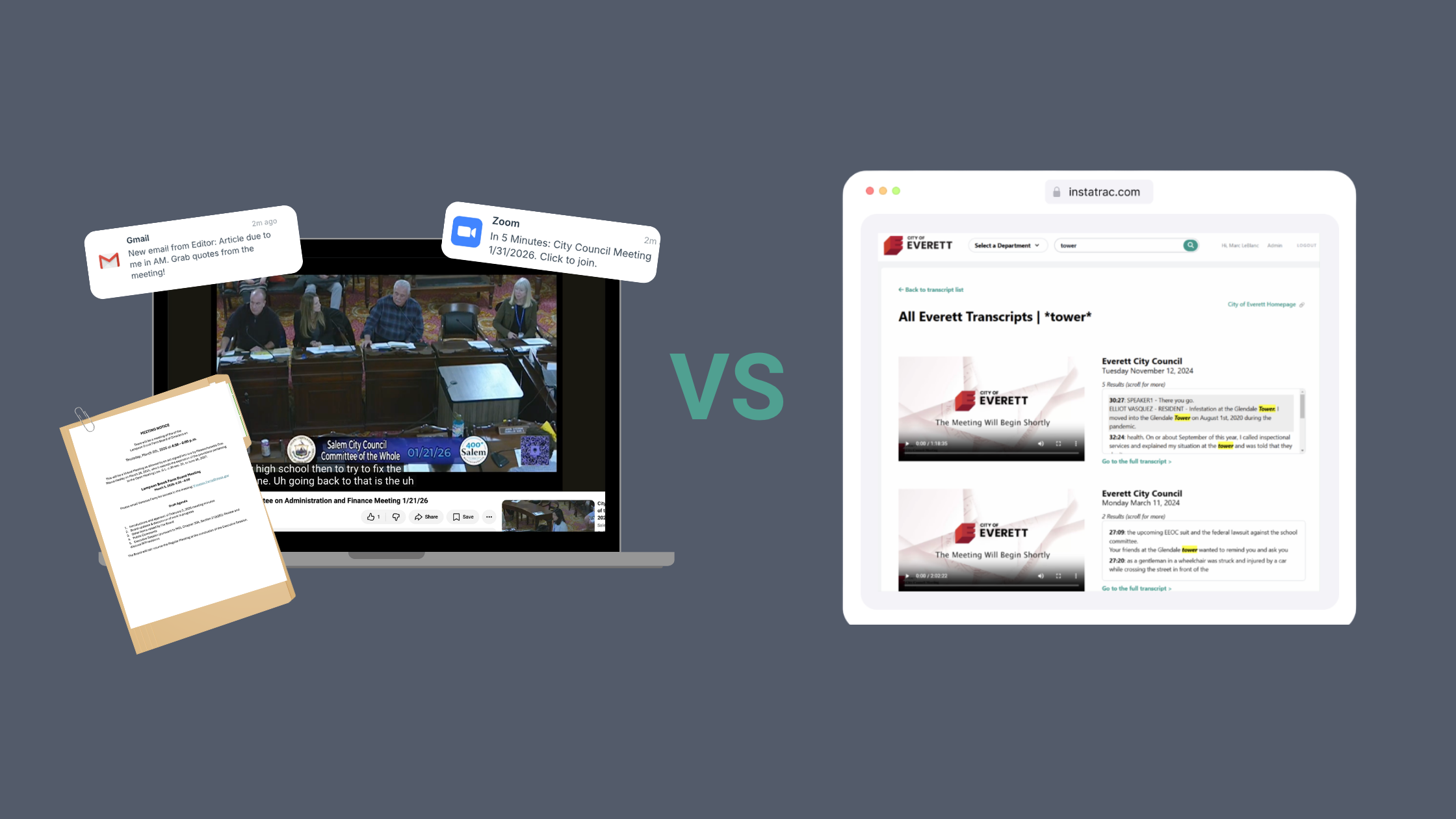
The transcript is what changes the reader's experience. People looking for a school policy, a budget line, or a vote on a specific warrant article shouldn’t have to scroll through dozens of PDFs or sit through two hours of recorded video. People also shouldn’t have to leave the city’s website to use the tool the town paid for.
That two-deliverable pattern is how MuniTrac by InstaTrac works in practice: clerks get AI-generated draft minutes for review, and the public gets a clickable, word-searchable transcript embedded on the city’s own website. Whatever platform you evaluate, ask whether the output is a static document or a living tool.
Proven Time Saving Methods
Look for proven time savings, not claims of them.
Ask vendors for specifics: how long from upload to final minutes? Is the draft reviewed by a human before it comes back to the clerk, or is it purely machine output? What happens when the audio is bad or the agenda changes mid-meeting?
This is where the “AI-generated, human reviewed” pattern matters. AI on its own produces a first draft. At InstaTrac, that’s how MuniTrac produces minutes and transcripts for Massachusetts cities and towns. And it’s the part Everett City Clerk Sergio Cornelio flagged when asked about the value:
“MuniTrac has allowed me to concentrate on other important work in my office while they produce accurate and timely meeting minutes.”
Whatever platform you choose, push for the same level of clarity about who or what is doing the work.
Built for the Size of Your Community
A town of 5,000 and a city of 50,000 don’t run the same operation. Committee cadence, agenda complexity, and staff capacity vary widely.
A good meeting records service scales with your needs rather than forcing you into a package designed for someone else. Ask how pricing works at your volume, not the vendor’s reference volume.
Local Expertise in Your State’s Operations
A vendor that serves municipalities across 50 states knows municipalities. A vendor that serves municipalities in one state knows yours.
A vendor fluent in your state speaks the same language as the people on the other side of the question. MuniTrac is built specifically for Massachusetts cities and towns. InstaTrac has been working in the Commonwealth’s government information ecosystem for more than 30 years — we know the towns, we know the people involved, and we know how Beacon Hill’s decisions flow down to the local level.
Whether you ultimately work with us in Massachusetts or another specialist, the point stands: a local vendor will understand your regulated world in a way a national service won’t.
The Bottom Line
The right municipal transcription and minute software does four things: it keeps you compliant, it makes your meetings accessible, it gives your staff their time back, and it understands the state you operate in.
Any platform that can’t clearly explain how it does all four isn’t the way to go.
If you work for a municipal board or committee in Massachusetts and are curious to know more, reach out to our team.