Breakdown of the House Ways & Means FY27 Budget Proposal
The Massachusetts House Ways and Means Committee released its fiscal year 2027 budget proposal on April 15, 2026 — a $63.3 billion spending plan that raises state expenditures by 3.6% over last year while navigating one of the more complicated fiscal environments Beacon Hill has seen in recent memory.
Here's what's in it, what's driving the cautious tone, and what to watch as the proposal moves through the legislative process.
The Top Line Numbers
The House Ways and Means proposal recommends slightly less spending — about $33 million less — than Governor Healey proposed in her January budget.
Per the Section 1A revenue table, the FY27 Grand Total across all budgeted funds is $62.8 billion, with $59.4 billion coming from the General Fund. The consensus tax revenue number agreed to by the House and Senate Ways and Means Committees, working with the Executive Office of Administration and Finance, is $44.9 billion — of which $33.3 billion is available for the FY27 budget after transfers to the pension fund, the MBTA, and other agencies.
The major line items in the proposal include:
- $22.41 billion for MassHealth
- $7.66 billion in Chapter 70 education aid to school districts — the highest level ever appropriated for Chapter 70
- $1.33 billion in Unrestricted General Government Aid (UGGA) to cities and towns
- $1.69 billion for UMass, state universities, and community colleges
- $2.24 billion for the Commonwealth's debt service
- $2.77 billion for the state's share of group insurance
- $470 million in operating transfers to the MBTA
- $604.96 million for MassDOT
Fair Share Revenue: $2.7 Billion in Surtax Spending
This is the fourth year that revenue from the Fair Share amendment will be allocated. Per the Section 1A revenue table, the Fair Share surtax is projected to generate $2.7 billion in FY27 — with $1.725 billion directed to education and $975 million directed to transportation via the Commonwealth Transportation Fund.
The committee is recommending roughly a 64/36 split between education and transportation — a similar division to past years, which tends to even out as lawmakers take up supplemental budgets to allocate surplus surtax funds.
On the education side, highlights include:
- $365 million for C3 Operational Grants to childcare providers
- $198 million for permanent universal school meals
- $127 million for Free Community College
- $85 million for MassGrant+ financial aid expansion
- $52.2 million in supplemental Chapter 70 funding to bring minimum per-pupil aid from $75 to $160
- $18 million each for the SUCCESS program at state universities and community colleges
- $5 million to continue the Green School Works program
On the transportation side, the $975 million directed to the Commonwealth Transportation Fund is distributed as follows:
- $470 million to the MBTA (all Fair Share funds), including $40 million for the MBTA Academy workforce pipeline
- $184.8 million in surtax revenue to Regional Transit Authorities
- $220.2 million transferred to the Mass Transportation Trust Fund
- $100 million for health and human services-related transportation
The Big Uncertainties
Budget writers were blunt about the pressures they were navigating. Challenges include a sluggish economy, eroding federal support, and two potential ballot questions that could reduce revenue while putting dollars back in taxpayers' pockets.
Federal funding cuts: For the second year in a row, House lawmakers pointed to Washington’s dysfunction — stemming from Trump administration federal funding cuts — as a major complicating factor in fiscal planning. MassHealth is the most exposed: the Executive Summary notes the committee is actively bolstering MassHealth's IT and administrative capacity to respond to federally imposed cuts and restrictions.
The income tax ballot question: A ballot question proposes to slash the state's income tax from 5% to 4%. House leaders warned it would create an immediate $800 million revenue hole in the very budget they just released. Income tax receipts account for $25.6 billion of the FY27 base revenue estimate — the single largest revenue line — making the stakes of any income tax reduction significant.
To prepare for future fiscal uncertainty, the bill also creates a new annual budget stress-testing requirement (Section 15): the Executive Office for Administration and Finance, in consultation with the Department of Revenue, will be required to conduct a multi-year budget forecast and evaluate potential economic stress impacts for at least the next three fiscal years, with a report due to the Ways and Means committees by October 31 each year.
Education and Local Aid
The budget fully funds the sixth and final year of the Student Opportunity Act's implementation — the 2019 law designed to make school funding more equitable across the Commonwealth. Chapter 70 is funded at $7.658 billion, a $296.5 million increase over the FY26 GAA. Total local aid across all programs reaches $10.05 billion.
The proposal also allots $653.4 million for special education circuit breaker reimbursements and full funding of charter school reimbursement at 100%.
The budget includes a $10 million reserve for school districts that have experienced unexpected enrollment drops among non-native English speaking students — a direct response to the impact of federal immigration enforcement on communities across the state.
On out-of-district special education transportation — a long-running cost driver for districts — the bill takes several concrete steps (Sections 31–33 and 51): it requires vendors to provide detailed cost breakdowns in bids and invoices, directs DESE to maintain a centralized database of procurement and contract documents, and commissions a study of the special education transportation marketplace, with findings due to the Legislature by July 1, 2027. A model procurement template and contract must be published by January 1, 2027.
Early Education and Care
The FY27 budget invests a total of $1.86 billion toward early education:
- $598.6 million to fund childcare for children served by DCF and DTA
- $623.6 million for childcare for income-eligible families
- $475 million for Commonwealth Cares for Children (C3) grants
- $20 million for Head Start
- $20 million for childcare resource and referral agencies
- $7.5 million for the Early Educators Scholarship Program
Housing and Homelessness
The FY27 budget includes $1.14 billion for housing and homelessness programs:
- $281.3 million for the Massachusetts Rental Voucher Program (MRVP)
- $258.6 million for the Emergency Assistance Family Shelter Program
- $210 million for Residential Assistance for Families in Transition (RAFT)
- $117.8 million for Public Housing Authorities
- $115 million for Homeless Individuals Assistance
- $82.3 million for the HomeBASE Program
- $10 million for Shelter Workforce Assistance
- $8.9 million for Home and Healthy for Good
- $8 million for a new Winter Beds line item (7004-0111)
The bill also requires any child under the age of 3 entering a shelter to be referred for an early intervention evaluation within 30 days (Section 34).
Health Care
Healthcare represents the most significant area of investment in the budget at a combined $32.369 billion, with $22.36 billion for MassHealth. Additional health highlights include:
- $184.1 million for the Bureau of Substance Addiction Services
- $183.6 million for the Substance Use Disorder Trust Fund
- $175 million for Chapter 257 rate increases for human service workers
- $83.9 million for Sexual Assault and Domestic Violence Services
- $30 million to increase nursing facility rates and support the caregiving workforce
- $12.5 million for safe and successful youth initiatives
PrEP coverage (Sections 28, 36, 40, 43–46): The bill prohibits health insurers — including MassHealth managed care organizations and the Group Insurance Commission — from imposing any patient cost-sharing, prior authorization, step therapy, or other barriers on pre-exposure prophylaxis drugs used to prevent HIV. This protection applies broadly across individual, group, and HMO coverage.
PrEP access upon release from incarceration (Section 38): State and county correctional facilities will be required to provide HIV-negative inmates committed for 30 days or more with counseling, evaluation, and a supply of PrEP drugs prior to release — at no cost to the inmate.
Connector Care pilot extension (Sections 48–49): The Connector Care expansion pilot program is extended from three years to four years, pushing the end date to 2028.
Acupuncture and Wellness Commission (Section 35). A new Commission on Acupuncture and Wellness is established within the Department of Public Health to study the potential for greater integration of acupuncture services in health care, with a focus on pain management, substance use disorder treatment, and wellness. Its first annual report is due January 1, 2027.
Dental coverage flexibility (Section 53): EOHHS retains the ability to set limits on adult dental services under MassHealth and the Health Safety Net, provided no coverage cap falls below $1,750 per patient.
Workforce Development
The FY27 budget includes several targeted workforce investments:
- $58.4 million for Adult Education
- $10 million for the Workforce Competitiveness Trust Fund
- $8.9 million for Career Technical Institutes
- $17.4 million for Summer Jobs for At-Risk Youth
- $3.3 million for the Registered Apprenticeship Program
The bill also creates a Workforce Productivity Sub-Fund (Sections 41–43) within the paid family and medical leave system, seeded with a $1 million transfer from the Family and Employment Security Trust Fund by December 31, 2026, to help small businesses with 50 or fewer employees manage the cost of covering temporary vacancies during employee leave.
Sheriffs' Offices
The proposal increases funding for the Commonwealth's 14 sheriffs' offices to $812.1 million, an increase of roughly $53 million over last year. The move follows an Inspector General report that found the budget process for sheriffs had become opaque and deeply flawed.
The proposal breaks funding into four itemized categories — operations, payroll, no-cost calls, and medication-assisted treatment — rather than the current blanket account approach. The outside sections go further (Section 65): sheriffs' offices must submit annual full-time employee caps to Administration and Finance through FY31, and no office may spend into deficit in FY27. If an office needs supplemental funding, it must submit documentation to A&F and the Comptroller before any supplemental budget is filed by the Governor.
Reitrement and Pension Changes
The bill includes a significant package of changes to the public employee retirement system. A 3% Cost Of Living Assessment (COLA) is provided on the first $13,000 in pension benefits (Section 67). Eligible long-tenured retirees who retired before July 1, 2020 with 20 or more years of creditable service and benefits below 80% of average annual salary would receive supplemental annual benefits: $100 after 10 years of retirement, $200 after 15 years, and $300 after 20 years (Sections 25–27).
The bill establishes a new Cost of Living Reserve Fund (Section 21), funded in part by directing 10% of excess investment income into the fund each year (Section 20). Per Section 22, Pension Liability Fund transfers are set at $5.13 billion for FY27, $5.34 billion for FY28, and $5.55 billion for FY29. Per Section 64, the excess capital gains threshold for FY27 is set at $2.25 billion, with excess capital gains distributed 65% to the State Retiree Benefits Trust Fund, 20% to the Stabilization Fund, and 15% to the Pension Liability Fund.
The bill also allows judges who are veterans to purchase up to four years of creditable military service toward retirement (Section 23).
Environment and Energy
The FY27 budget includes the following:
- $153.3 million for the Department of Conservation and Recreation
- $81.1 million for the Department of Environmental Protection
- $63.4 million for the Clean Water Trust Contract Assistance
- $60 million for Emergency Food Assistance
- $10 million for the Massachusetts Clean Energy Center
- $5 million for the Green School Works program, continuing a three-year initiative to decarbonize public schools
Public Safety
The FY27 budget provides the following:
- $925.5 million for the Department of Correction
- $812.1 million for the 14 sheriffs' offices
- $603.9 million for the Department of State Police
- $10 million for the Communications Access Trust Fund for no-cost calls in prisons and jails
- $10.1 million for the Senator Charles E. Shannon Anti-Gang Grant Program
- $6.9 million for the Emerging Adults Pre- and Post-Reentry Program
Criminal Justice
Sexual assault kit retention (Sections 29–30): Local law enforcement must retain sexual assault evidence kits for a minimum of 15 years. The bill also extends the statute of limitations for certain sexual assault offenses when the perpetrator's identity is established after the limitation period through DNA analysis of evidence collected at the time of the offense (Section 47).
Electronic service in child protection proceedings (Section 37): Courts will be permitted to allow electronic service of notice on parents in care and protection proceedings when identity or whereabouts are unknown — including through publication on a designated website or other electronic means reasonably calculated to reach the parent.
Sports Wagering Revenue Reallocation
The bill redirects a portion of Sports Wagering Fund distributions (Sections 7–8): the Workforce Investment Trust Fund's share drops from 17.5% to 10%, while a new 7.5% share goes to the Sports and Entertainment Events Fund — created last November to provide matching grants for major sports and entertainment events in Massachusetts.
Category 1 gaming revenues are also redistributed for FY27 (Section 63), with 31.5% going to the Gaming Local Aid Fund, 20% each to the Commonwealth Transportation Fund and Education Fund, 13% to the Gaming Economic Development Fund, and the remainder split among public health, community mitigation, racing, arts, and tourism funds.
Tenant Brewers and Distillers
The bill establishes a formal licensing system for tenant brewers and tenant distillers (Section 39), allowing licensed producers to manufacture or package their product at another company's facility under an approved alternating proprietorship arrangement. The license carries an annual fee of $1,000 and comes with detailed record-keeping.
What Comes Next?
The House will take up amendments over the coming weeks, meaning the final price tag is likely to rise before the full chamber votes. The proposal then heads to the Senate, which will produce its own version — and from there, a conference committee will reconcile the two before sending a final budget to the Governor's desk. The act takes effect July 1, 2026.
Tracking the Budget as it Moves
A proposal this size — dozens of outside sections, hundreds of line items, and amendments still to come — changes significantly between Ways and Means release and final enactment. A few tools that help budget-watchers stay on top of it:
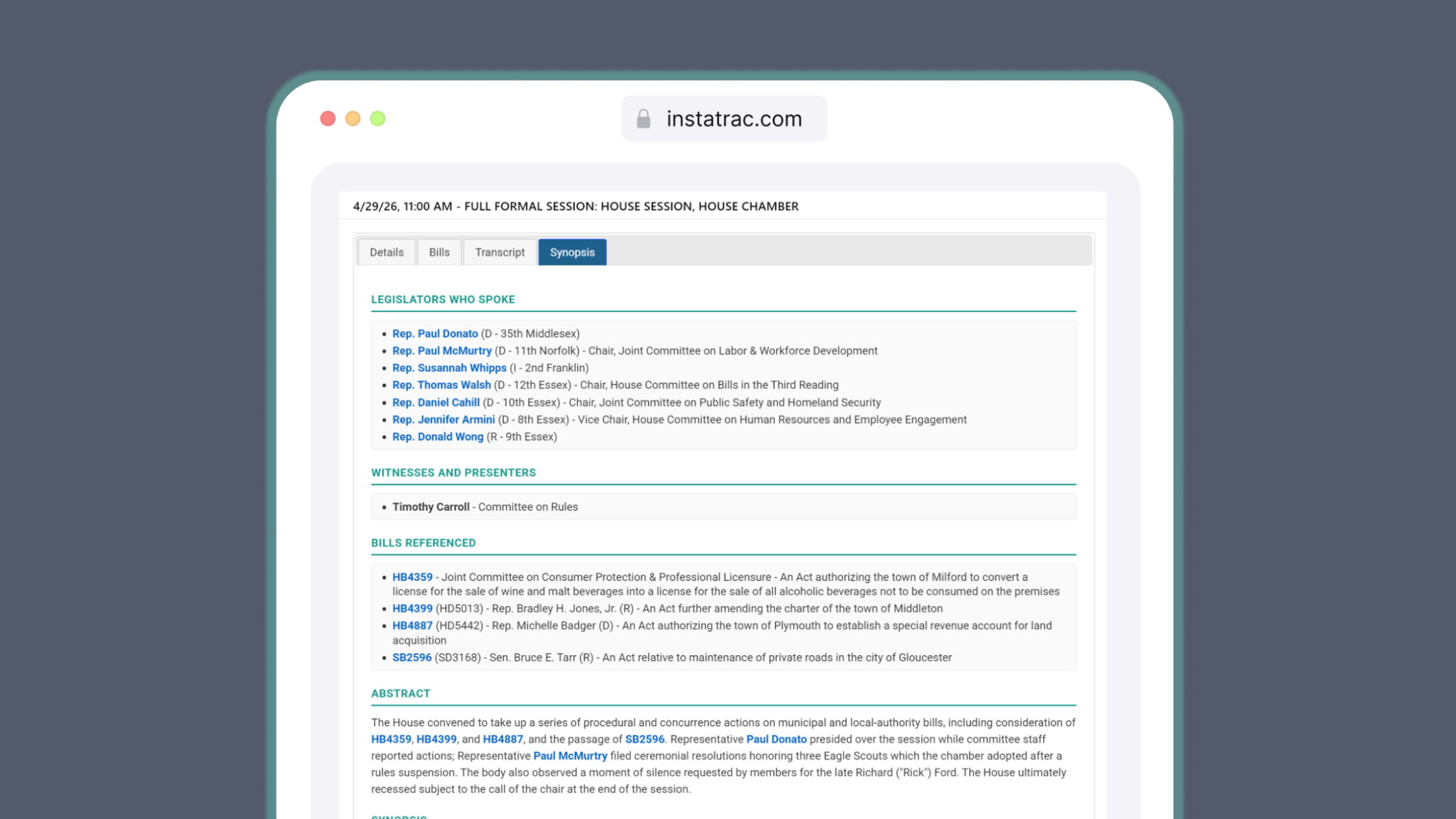
Line item tracking. Every appropriation in H.5500 is indexed in MassTrac, so you can pull up a specific account, see its funding history across fiscal years, and monitor it for changes as the budget moves through the Senate and into conference.
Amendment summaries. Once House debate opens, members will file hundreds of amendments. MassTrac summarizes each one in plain language — what's being proposed, who filed it, and which accounts it affects — so you're not reading every amendment in full to find the ones that matter to you.
Section-by-section summaries. The outside sections of a budget bill are easy to overlook but often carry significant policy changes. MassTrac's legal team produces plain-language summaries of every section, so you always know what the bill actually does, not just what it appropriates.
Alerts. Set up alerts on the line items, sections, or bill activity relevant to your organization. When something changes — a committee vote, an amendment adoption, a new version of the bill — you'll hear about it without having to check back manually.
If you'd like to learn more about InstaTrac's services, we'd be glad to chat!