Breakdown of the Senate Ways & Means Budget
On May 5, the Senate Committee on Ways and Means released its fiscal year 2027 budget recommendations—a $63.3 billion spending plan that reflects the Commonwealth's response to federal uncertainty and rising costs. Here's a plain-English breakdown of what’s in it.
The Big Picture Numbers
The Senate budget totals $63.30 billion—$2.3 billion higher than FY2026 spending and $66 million above the Governor's proposal.
General Fund appropriations: $62.46 billion
Retained Revenue authorization: $836.3 million
The budget is based on a tax revenue estimate of $44.9 billion in available revenue, a 2.4% increase over FY2026. $2.7 billion in expected Fair Share surtax revenue is included.
Major appropriations include:
$22.74 billion for MassHealth
$7.66 billion for Chapter 70 aid to school districts
$2.77 billion for the Commonwealth's group insurance
$2.24 billion for debt service (interest, sinking funds, and serial bonds)
$1.72 billion for higher education (UMass, state universities, and community colleges)
$1.38 billion for unrestricted local government aid
$604.96 million for MassDOT
$470 million for MBTA operating transfer
$217.45 million for regional transit authorities
Fair Share Money
Fair Share surtax revenue is now in its fourth year.
Education: $1.7 billion
$576 million - Final year of Student Opportunity Act implementation
$375 million - Commonwealth Cares for Children (C3) grants (matched with $100M from operational grants = $475M total)
$180 million - Universal Free School Meals
$137 million - Free community college statewide
$124.7 million - Income-eligible child care
$119.4 million - DCF and DTA-related child care
$85 million - MASSGrant Plus financial aid
$59 million - School transportation reimbursement
$28.4 million - Commonwealth Preschool Partnership Initiative (CPPI)
$14 million - State University SUCCESS funding
$10 million - UMass SUCCESS funding
Transportation: $1.44 billion
$550 million - Commonwealth Transportation Fund
$470 million - MBTA operations (combined with $535M from Fair Share supplemental equals $1 billion total)
$220 million - Massachusetts Transportation Trust Fund
$185 million - Regional Transit Authorities ($217.5M total including base funding)
Includes $40 million for fare-free fixed-route service across all RTAs
Spending by Category
Education
A major theme heard from educators and testifiers was that the formula for distributed Chapter 70 funds needs to be reevaluated. To meet their needs, the Senate budget reconvenes the Foundation Budget Review Commission (Section 27). This commission will examine whether the current formula adequately reflects the needs of all school districts—urban, suburban, regional, vocational-technical, and rural—nearly seven years after the Student Opportunity Act became law.
K-12 Investments:
$852.6 million - Special Education Circuit Breaker (including $200M from Fair Share supplemental) for 75% reimbursement of tuition and transportation
$114.2 million - Regional school transportation (90% reimbursement)
$20 million - Rural school aid ($8M increase over FY26)
$200.4 million - Charter school reimbursements
Early Education & Care:
$623.6 million - Income-eligible child care
$597.2 million - DCF and DTA-related child care
$475 million - C3 operational grants
$48.1 million - EEC quality improvement
$28.45 million - CPPI pre-K access
$20 million - Child care resource and referral centers
$20 million - Head Start grants
$5 million - Childhood mental health consultation
Higher Education:
$884 million - UMass
$419.4 million - 15 community colleges
$409.8 million - 9 state universities
$176.6 million - Massachusetts State Scholarship Reserve
$137 million - Free community college
$38 million - Higher education wraparound services
$5 million - Massachusetts Inclusive Postsecondary Education Initiative (MAIPSE)
Local Aid
Unrestricted General Government Aid (UGGA) has also been a hot button issue, especially seen with the House debates. The Senate is proposing:
Total UGGA: $1.376 billion
Increase over FY2026: $53 million
Other Municipal Support:
$217.5 million - Regional Transit Authorities (including $40M for fare-free service)
$55.3 million - PILOT payments for state-owned land
$53.4 million - Libraries
$19.4M regional library aid
$20.4M municipal libraries
$6.3M technology and automated resource networks
$27.4 million - Massachusetts Cultural Council
Health & Human Services
MassHealth:
MassHealth is, as usual, the largest appropriation allotted for in the budget, coming in at $22.74 billion. It is an increase of 2.8% from last year’s budget, covering 1 in 9 Massachusetts residents.
The Senate budget also includes language allowing EOHHS to impose coverage caps on adult dental services with a $1,750 minimum cap—a departure from current policy that advocates say could affect low-income adults' access to oral health care (section 42).
Mental Health:
$694 million - Adult support services (includes $19M jail diversion)
$395.1 million - DMH hospital and community services
$136.7 million - Children's mental health
$27.4 million - Statewide homeless services
$25 million - Emergency department diversion
$6.2 million - Community health center workforce support
Public Health:
$256.4 million - DPH hospital operations
$192 million - Bureau of Substance Abuse Services (BSAS)
$84 million - Domestic violence prevention
$38.3 million - Early intervention services
$31.7 million - HIV/AIDS treatment and prevention
$29 million - State Lab and Disease Unit
$25 million - Family and adolescent reproductive health
$22 million - School-based health programming
$19 million - Maternal and child health
$15 million - Local and regional board of health grants
$14.4 million - Suicide prevention (fully funds 988 lifeline)
Children & Families:
The federal "One Big Beautiful Bill Act" (OBBA) enacted the largest SNAP cuts in history. Around 100,000 Massachusetts residents may lose benefits, and starting FY2028, Massachusetts could face up to $447 million annually in new cost-sharing obligations.
To address the cuts the Senate proposes:
$147.7 million - DTA caseworkers
$55.2 million - Emergency food assistance
$29.7 million - Healthy Incentives Program (HIP)
$15.5 million - WIC Nutrition Program
$437.3 million - Transitional Aid to Families with Dependent Children benefits
$204 million - Emergency Aid to the Elderly, Disabled and Children benefits
$343.4 million - DCF-involved children and families services
$320.9 million - DCF social workers
$129.6 million - DCF family support and stabilization
$35 million - Family resource centers
$500 per child - School clothing allowance
People with Disabilities:
$2.07 billion - Community residential services
$372.3 million - State-operated residential services
$313.5 million - Community day and work programs
$131.4 million - Respite and family services
$110.4 million - Children's autism services
$110.3 million - Turning 22 program
$102.5 million - Specialized services for adults with autism
A win for many advocates in the disability space are pleased to see Section 37 of the outside sections in the proposal, which creates a special commission to study gaps in transitional planning services for young people with disabilities aging out of special education (graduating or turning 22).
Other Disability Services:
$33.1 million - Head injury treatment
$31.9 million - Massachusetts Commission for the Blind
$29.2 million - MassAbility vocational rehabilitation
$13 million - Disabled Persons Protection Commission
$11.3 million - Commission for the Deaf and Hard of Hearing
$8.5 million - Independent living centers
Aging Services:
$505.4 million - Community Choices program
$412.3 million - Elder home care and case management
$51.6 million - Protective services (prevent abuse/neglect)
$29.2 million - Councils on Aging grants ($16 per elder)
$19.5 million - Executive Office of Aging and Independence
$14.1 million - Congregate and supportive senior housing
$13.4 million - Meals on Wheels and nutrition programs
$2.5 million - Geriatric mental health services
Housing
$278 million - Massachusetts Rental Voucher Program (11,500+ vouchers)
$258.6 million - Emergency assistance family shelters
$201 million - Residential Assistance for Families in Transition (RAFT)
$117.8 million - Local housing authorities
$114 million - Homeless individual shelters
$82.3 million - HomeBASE program
$27.3 million - Homeless programs administration
$21.8 million - Executive Office of Housing and Livable Communities
$19.2 million - Alternative Housing Voucher Program (AHVP)
$10 million - Sponsor-based supportive permanent housing
There are also several outside sections to streamline local permitting and encourage housing production.
Key changes include:
Structures on lots with pre-existing dimensional nonconformities may be extended/altered as-of-right if compliant with current height, story, and setback regulations
Building permits are maintained zoning standards in place at the time of application through to the issuance of the permit.
A permit granting authority is required to include the public interest in housing production as a factor when approving variances.
Allows for permits electronic delivery of required notices
Environment
$153.8 million - Department of Conservation and Recreation
$80.4 million - Department of Environmental Protection
$67.2 million - Department of Agricultural Resources
$28.4 million - Department of Public Utilities (includes $3.6M Energy Facilities Siting)
$10 million - Massachusetts Clean Energy Center transfer
$9.5 million - Division of Marine Fisheries
$7.3 million - Department of Energy Resources
$5.1 million - Division of Ecological Restoration
$4.3 million - Climate adaptation and preparedness
Judiciary & Public Safety
Justice System:
$1 billion - Trial Court system
$380 million - Committee for Public Counsel Services
$206.4 million - Office of Probation
$51 million - Massachusetts Legal Assistance Corporation
$3.4 million - Mental Health Legal Advisors Committee
$3.4 million - Prisoners' Legal Services
Public Safety & Law Enforcement
$810.2 million - Sheriff's offices statewide
$607.7 million - Department of State Police
$34.4M State Police Crime Lab
$10.4M new cadet class
$187.1 million - District Attorney offices
$87.8 million - Office of the Attorney General
$45.1 million - Department of Fire Services
$28.6 million - Office of the Medical Examiner
$24.5 million - Massachusetts Alcohol and Substance Abuse Center
$22.1 million - Municipal Police Training Committee
$16.1 million - Community-based residential re-entry services
$10.1 million - Shannon Grants (gang violence prevention)
$9.6 million - POST Commission and police reform commissions
$7 million - Emerging adult reentry program
$5 million - Non-profit security grants
Sheriff Fiscal Oversight (Section 40)
The Senate proposes several restrictions relating to the finances of sheriff's offices, including hiring and spending controls to restrict the number of employees and prevent spending into deficiency; requires any requests for supplemental spending to be submitted to A&F and the comptroller prior to the filing of a supplemental budget by the Governor; and creates a new sheriff fiscal oversight council within EOPSS.
Veterans
$85 million - Veterans' benefits (cash, fuel, rent, employment, health)
$45.4 million - Chelsea Soldiers' Home
$36.8 million - Holyoke Soldiers' Home
$12.5 million - Executive Office of Veterans' Services
$9.5 million - Veterans' outreach centers
$3.9 million - Transitional and housing assistance for homeless veterans
$2.5 million - Home Base mental and behavioral health services
$1 million - Office of the Veterans Advocate
$721,444 - Outreach and services for women veterans
Economic & Workforce Development
$15.3 million - YouthWorks (summer jobs for at-risk youth)
$9.9 million - MassHire Career Centers
$8.9 million - Career Technical Institutes
$5 million - Massachusetts Technology Collaborative
$4.95 million - Small business technical assistance
$1 million - Regional economic development organizations
$1 million - Employment programs for young adults with disabilities
Track the Budget Process with MassTrac
As the FY2027 budget moves through conference committee and floor debate, staying informed about the hundreds of amendments, line-item changes, and policy provisions can be overwhelming. That's where MassTrac becomes an essential tool for government affairs pros.
How MassTrac Helps You Navigate Budget Season:
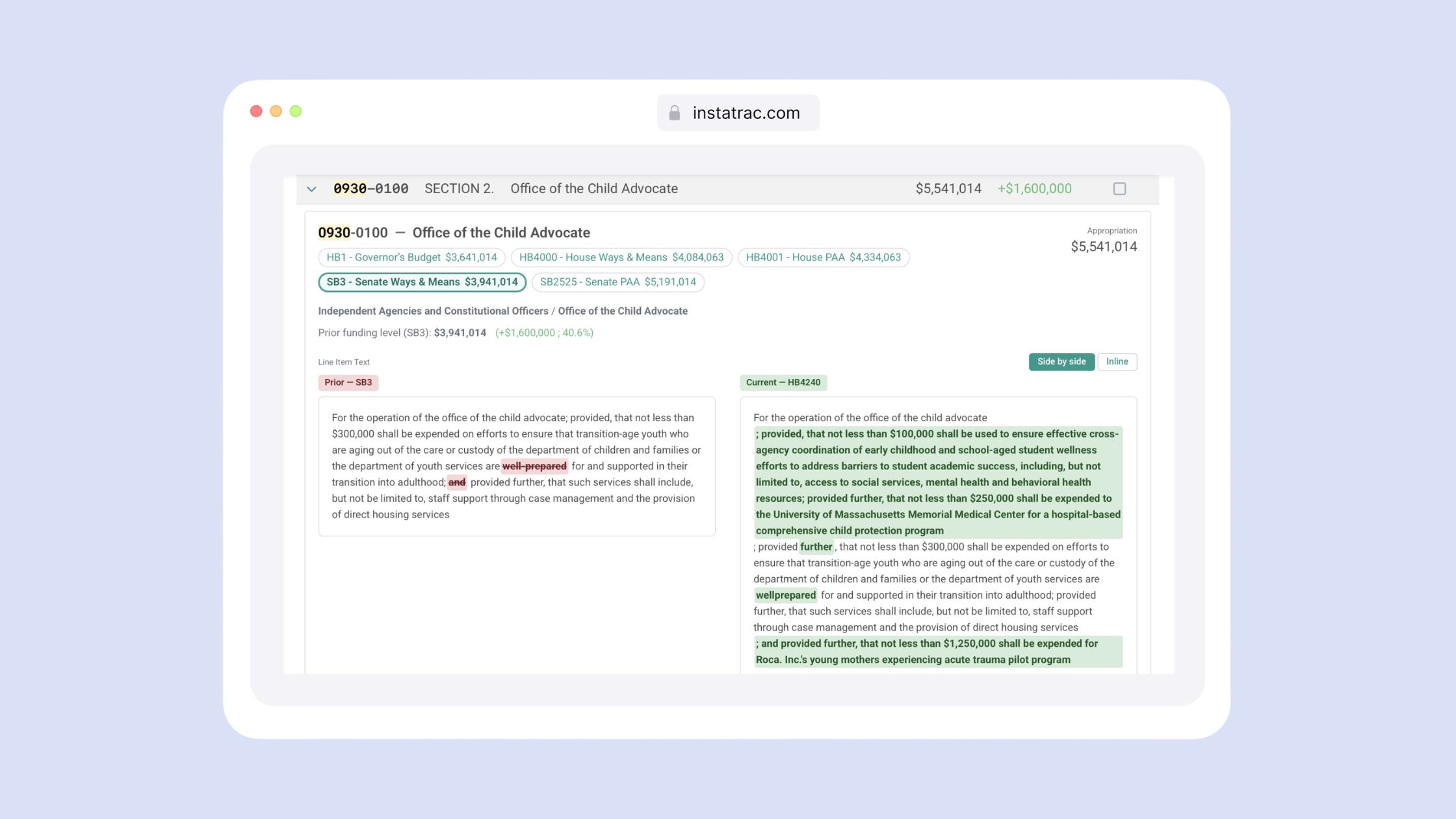
Line-Item Comparison Tool Compare funding levels across the House budget (H.5501), Senate budget (S.4), and the Governor's budget (H.2) side-by-side. See exactly which chamber is proposing more funding or less, and filter by secretariat, agency, or specific program to quickly identify where your priorities stand.
Amendment Tracking During floor debate, hundreds of amendments are filed to both the House and Senate budgets. MassTrac allows you to track specific amendments by sponsor, topic, or line item affected. Set up custom alerts to be notified when amendments affecting your issue area are filed, debated, or adopted. Never miss an amendment that could impact your community or organization.
Amendment Summarization Reading through dense legislative language can be time-consuming. MassTrac's legal department summarizes every amendment and outside section in plain-English. Quickly understand whether an amendment increases funding, or shifts resources between programs.
Section-by-Section Analysis For outside sections, MassTrac provides section-by-section breakdowns with plain-language summaries. Understand what a section does without parsing through pages of statutory references. See which sections are in both budgets, which are unique to one chamber, and which are likely to be contentious in conference committee.
View our Section-by-Section Analysis for SB4
Book a call with one of our experts to explore the platform's budget tracking features. The FY2027 budget cycle is moving quickly—don't navigate it blind!